Saturday, June 20, 2015

Is Stoning Instructed in Quran ?

   There is a misconception among the traditional societies particularly in the Middle East where it is commonly believed that stoning is somehow associated with Quran and it is a sentence  authorized by Quran.  In most cases when they are asked to provide any proof for their claim they mention that the word "Rajm" meaning stoning has been stated in Quran.   Below are the five verses in which this word is used in reference to stoning.  

1:1


11:9111:91

They said, "O Shu'ayb, we do not understand much of what you say, and indeed, we consider you among us as weak. And if not for your family, we would have stoned you [to death]; and you are not to us one respected."

18:20
18:20
Indeed, if they come to know of you, they will stone you or return you to their religion. And never would you succeed, then - ever."


19:46
19:46
[His father] said, "Have you no desire for my gods, O Abraham? If you do not desist, I will surely stone you, so avoid me a prolonged time."


26:11626:116
They said, "If you do not desist, O Noah, you will surely be of those who are stoned."


36:1836;18

They said, "Indeed, we consider you a bad omen. If you do not desist, we will surely stone you, and there will surely touch you, from us, a painful punishment."

                                                                            صدق الله العلي العظيم

   As it is obvious "stoning" is mentioned in these verses only as a threat or as a potential punishment by the infidels offered to the prophets thereby forcing them to stop inviting people to God.  There is absolutely no verse  in Quran where God has set "stoning" as a punishment for any sin or any crime. 

   The question that follows naturally is what then "stoning" is based on as a sentence in those societies.  I believe the only imaginable sources it can be associated with is Hadith and Sunnah. While I have no knowledge of any of these two respectable sources, it is only reasonable to assume that if "stoning" is based on a hadith it is either not a true one or even more reasonably we can say it does not matter which source it comes from.  It is inhuman, immoral and not acceptable to anyone in the right mind.  It is very hard to believe that the religion which has stopped the tradition of burying infant-girls alive would legitimize such punishments.    

   I believe in many of such cases where personal emotional reactions have become a norm, a tradition, it appears that the followers of the religion tend to run over God's commandments thinking that the harsher they react the better God would like their action while in truth it is only to fulfil their personal interests and desires.   Everyday examples include reaction of people from different religions toward anything they gather as an insult to their sacred book, prophet or places. 

     That said, we have to trace religious fanaticism and extremism, generally speaking, in cultures and in individual circumstances rather than blaming it on Quran. 


Thursday, June 18, 2015

Can We Make Our Heart Love ?

   
   Often times we hear that we either feel love in our heart or we don't, there is nothing we can do about it.  Love either already exists or it doesn't we can not create it, in other words.  Well, I am not sure if that is entirely true. 

   How about if we don't eat for long hours of hot summer days because we want to make our heart feel there is something for which we deprive our self from the most basic needs. We willingly take on an apparent trouble for our body to go beyond the martial needs, to hear the voice and to see the light that we would otherwise don't.  It starts from our will, from our wish to change, to make our heart change, to force our perceptions sense a world beyond what the five senses show us, to see the unseen, in truth.    As a result of this seemingly physical action we feel different, our heart feels totally revived.  Keep repeating such actions, or even not, we feel the love that has engulfed our heart and we see the light that has enlightened the world.   Ramadan Mobarak, this is the time we can rejuvenate our heart.   

   Do we have to inflict upon our self 18 hours or so of fasting while we find it unbearable considering our personal circumstances?  I don't think so. We are only expected to try our best for God. What matters, first and for most, is to keep trying good deeds for him ,to the extent that we can afford,  which will shape our true nature for the after life. 


1:1


53:3953:39 
And that there is not for man except that [good] for which he strives

79:35
79:35
The Day when man will remember that for which he strove,

76:2276:22
 "Indeed, this is for you a reward, and your effort has been appreciated."

20;15
20:15
Indeed, the Hour is coming - I almost conceal it - so that every soul may be recompensed according to that for which it strives.


 صدق الله العلي العظيم

Quran Quotes from Quran.com

Saturday, May 2, 2015

How Similar We Are to Moving Creatures?

1:1


6:386:38
Sahih International
"And there is no creature on [or within] the earth or bird that flies with its wings except [that they are] communities like you. We have not neglected in the Register a thing. Then unto their Lord they will be gathered."


45:4
45:4Sahih International
"And in the creation of yourselves and what He disperses of moving creatures are signs for people who are certain [in faith]."
(from Quran.com)

   Although it is an obvious fact that Quran has not been intended to be a science guide for men to discover the world and expand his worldly knowledge, there are fascinating verses every now and then, which are meant to be undeniable signs of God in the nature all around us.  Our similarities with all moving creatures on earth is one of such cases. 

  We can probably study the resemblance between human and moving creatures in two aspects, physical and behavioral. 

  Physically, the first striking similarity in appearance is the symmetrical structure of their bodies.  All moving creatures from insects to animals, birds and human seem to have an amazing symmetry which makes us wonder what it could represent.  Of course, if you ask this question from a science educated person, as I asked,  S/he may answer "Since life grows through a basically symmetrical process of cell division, symmetry in larger forms should not be in any way surprising." Kevin Colby from "Philosophy of Mind", a Google community. 

   I believe it is the same argument with rain and all the other natural phenomena.  If you ask an atheist what is the reason for rain they would most probably tell you that it is about one of the most basic natural science concepts that is the cycle of evaporation and condensation of water.  They will even go further proving their case by explaining that today human is capable of manipulating the water molecules in air and create rain without divine intervention.

   So, while it is true that physical cause of rain or generally the cause for all natural phenomena is another natural cause, a disbeliever would deny a metaphysical driving force underlying the chain of natural causes.  This is despite the fact that throughout Quran God keeps reminding us that there is no slightest movement taking place on earth ,a falling tree leaf for example, without his permission and his knowledge, as emphasized in the verse 6:59. Quran basically claims that it is indeed God who is the only cause for all that is happening in the whole universe.

  We can therefore, see that we may never be able to directly link the seen world to the unseen through science which is based on our five senses unless we want to see God as the ultimate cause of all the developments of the seen world, no matter how small or how large they are.  That is why it will be always a matter of faith ,which is based on findings of our heart, to believe in the unseen in order to qualify for being guided by God.  The kind of guidance that ,for the most part, consists of being  exposed to God sings and miracles on a personal levand and on daily basis, recognizing which would increasingly enable us to see more of God's light lighting the whole world as we move along our life.

   The second physical similarity between us and other moving creatures is having the two main organs of brain and heart.  While I do not have any expertise in biology and I have no intention of providing any scientific claim, it appears some insects, bees and ants (termite) included, have a heart.  What is special with bee and termite is that they are mentioned in Quran in verses 16:68, 16:69 and 34:14.  As stated God has inspired them directly to do specific tasks.

   As far as the behavioral similarities are concerned, in all moving creatures from the insects to the largest animals and including birds they all seem to demonstrate a kind of decision making behavior in their daily life.  That is to say, they all have to go through a thinking process to find their food, to hunt, to keep away from danger and so on.  what is most interestingly is the fact that they also show sings of hesitation when they are deciding based on the information they gather from their environment. This clearly means they have a freedom of choice to a certain degree like human.

  Another amazing behavioral aspect of moving creatures is that they all seem to have feelings and emotions.  The numerous videos on the Internet showing one animal helping another of his species or even from other species ,in rare cases, evidence this. Also they way they take care of their family members or show emotional reactions to human is more or less corroborating the same fact.   Dogs of course are known to have the highest emotional understanding when it comes to interactions with human.

   Based on the above arguments, I wish to draw the following conclusions as a matter of personal opinion.
  1. The similar physical symmetry in the appearance of the body and in the main organs of moving creatures including birds with that of human could mean that these creatures have also a metaphysical side of their being which is commonly referred to as soul in a very general sense.  
  2. Having the same main organs of brain and heart as human's could mean that other moving creatures potentially have a freedom to choose between good or bad through a kind of thinking process similar to human's and also because they have heart they could be inspired by God directly again similar to the same capability of men.   
   Finally, we can perhaps, conclude that since all moving creatures have souls, have freedom of choice, and they can be inspired by God hence they will also be held accountable for their actions just like human will in after life.  This is how I believe the first verse at the top of this page can be understood when God says :

"And there is no creature on [or within] the earth or bird that flies with its wings except [that they are] communities like you. We have not neglected in the Register a thing. Then unto their Lord they will be gathered."

 صدق الله العلي العظيم


From Google images

Monday, April 27, 2015

What does “Fear of God” mean in Quran?


1:1

   There are three words “Tagva”, Khashyah” , and “Khouf” from Quran which have been equally translated to fear in most translation of Quran as far as I have seen.  While it appears that in most cases they could mean the same thing at the first glance, I believe, they are meant to convey delicate nuances which may lead to significant differences in the way we know God.   After all, the extraordinary choice of words throughout Quran never ceases to amaze me.  That is for sure one of the clear signs testifying that this text can only be the words of God.


    As I have already mentioned my understanding of “Tagva” in a previous post, I will be focusing on the other two words “Khashyah” and “khouf” in this one.   The following verses are a few samples where “khashyah” is used:

2:45
2:45

Sahih International
"And seek help through patience and prayer, and indeed, it is difficult except for the humbly submissive "[to Allah ]


79:19 
79:19
Sahih International
"And let me guide you to your Lord so you would fear [Him]?'"


79:2679:26
Sahih International
"Indeed in that is a warning for whoever would fear [ Allah ].


17:31
17:31
Sahih International
"And do not kill your children for fear of poverty. We provide for them and for you. Indeed, their killing is ever a great sin."


    What is in common in the way the word "khasiah" خشیه has been used in the above verses, is in fact its connotation of a current concern for a future event.   Just like "tagva" تقوا,  khasiah is also a state of heart in which fear of doing something that God may not like is present.   That is not to say, doing something out of a blind fear but it is doing or avoiding an action of the fear of losing God's satisfaction.  That means asking ourselves continuously what if God does not like it and then you avoid doing that.  In contrast "tagva" is doing something that God likes, you know that he likes you to do this or he likes you avoid something.   Perhaps, we can see "Tagva" and "khashia" as the two sides of one coin which is the love of God. 

And blew are a few verses including "khouf" or fear:

13:12
13:12
Sahih International
"It is He who shows you lightening, [causing] fear and aspiration, and generates the heavy clouds."


79:40
 Sahih International
79:40"But as for he who feared the position of his Lord and prevented the soul from [unlawful] inclination,"

3:1753:175
Sahih International
"That is only Satan who frightens [you] of his supporters. So fear them not, but fear Me, if you are [indeed] believers."


I believe, what the word "khouf" خوف, commonly represents in the above verses is the fear that results from feeling powerless, feeling tiny, and feeling humble in encountering God's manifestations of his greatness.   This is the kind of fear we feel when we see and hear a lightening or we look into the universe and it is not the fear of a punishing God that forces his servants to blind obedience.

One may argue that there are many warning verses in which dire consequences such as hellfire is notified. Don't they cause any fear ?  Yes, of course the detailed descriptions of hell are truly dreadful.  Yet, amazingly enough, God has repeatedly clarified that these are the consequence of our actions. In other words, we, ourselves, are choosing the severe hardships that we may have to go through on our path of eternal spiritual evolution.   God is frequently emphasizing and warning us to avoid or to keep away from that path which is the hard way of learning and evolving.

Therefore, keeping in heart the greatness of God is a strong deterrent against giving in to our ego.  In the meantime, God's greatness can empower  us with a hope that even in the darkest situations of life God's will can prevail and there is no reason to become hopeless ever.  There is vidoe on youtube in which a man is free jumping from space interestingly just before he jumps (around minute 2:05) he says, "sometimes you have to be really high to see how small you are" https://www.youtube.com/watch?v=VKojXTWJIhg. 

Finally, we may have heard that Quran is a live book and may have wondered what it means. So in case we were seeking God's help to distinguish between these three words (as I were) we may accidently find this verse (as I did) which miraculously presents "Tagva", "khashia" and "khaouf" all in one verse.


4:9
4:9
Sahih International
"And let those [executors and guardians] fear [injustice] as if they [themselves] had left weak offspring behind and feared for them. So let them fear Allah and speak words of appropriate justice."


                                                              صدق الله العلي العظيم

Saturday, April 4, 2015

What Does Eating Wine and Bread Symbolize in Christianity?


1:1


While verses of 5:110 through 5:119 address the major principles behind Christianity, 112-115 seem to be least noticed in discussions, as far as I have seen.   Here are the verses and their translation from www.Quran.com 

5:111
5:111
Sahih International
And [remember] when I inspired to the disciples, "Believe in Me and in My messenger Jesus." They said, "We have believed, so bear witness that indeed we are Muslims [in submission to Allah ]."

5:112
5:112
Sahih International
[And remember] when the disciples said, "O Jesus, Son of Mary, can your Lord send down to us a table [spread with food] from the heaven? [Jesus] said," Fear Allah , if you should be believers."

5:113
Sahih International
5:113
They said, "We wish to eat from it and let our hearts be reassured and know that you have been truthful to us and be among its witnesses."

5:114
5:114
Said Jesus, the son of Mary, "O Allah , our Lord, send down to us a table [spread with food] from the heaven to be for us a festival for the first of us and the last of us and a sign from You. And provide for us, and You are the best of providers."

5:115  

5:115
Allah said, "Indeed, I will sent it down to you, but whoever disbelieves afterwards from among you - then indeed will I punish him with a punishment by which I have not punished anyone among the worlds."

It appears to me that this is the true story behind the famous “Last Dinner” of Jesus in Christian faith as celebrated by eating bread and wine.  It is also the subject of "Last Dinner" paintings where Jesus is eating with his disciples at a table. Quran account is clearly in contrast to the Bible’s story:
Jesus Christ, at His last meal with His disciples, commanded His friends and followers to remember Him in a specific way. Although He had earlier warned them of His approaching death (John:12:32-33)

"...When He had given thanks, He broke [the bread] and said, 'Take, eat; this is My body which is broken for you; do this in remembrance of Me.' In the same manner He also took the cup [of wine] after supper, saying, 'This cup is the new covenant in My blood. This do, as often as you drink it, in remembrance of Me'" (1 Corinthians:11:24-25).


According to the above lines of the Bible the main idea behind the tradition of eating bread and wine is to be reminded of Jesus and one’s dedication to him.

From Quranic point of view firstly, if God forbids intoxicants, as discussed in a previous post, it does not make sense to recommend people to drink wine as his reminder. Secondly, if Jesus is God’s messenger he should be inviting people to eat something in order to remember God not himself. 

Christianity’s view is understandably different however.  Nevertheless, one would argue if wine has ever been associated with a spiritual feeling at all.  To judge a tradition we should evaluate its effect. That is to say, one can form an idea about the truth behind a religious tradition or ritual by wondering about its spiritual impact.  

While it is true that the intention of doing a ritual can greatly influence its outcome, we are to constantly examine the spiritual benefits of anything we do in the name of religion in order to keep the virtue of the original rituals introduced by any religion.  

In other words, if religious traditions and rituals deviates from their original meaning and purpose they will become ineffective and useless to us.  That is why believers of all faith, including Muslims, should question the true meaning and purpose of any tradition or practice suggested by their religion.  Otherwise, a true religion, over time, may be converted to meaningless and baseless superstitions that may do more harm than good to human as it may be the case for certain religions today.

Sunday, March 15, 2015

The Reward and Punishment System in Quran


1:1


 5:98  
5:98
“Know that Allah is severe in penalty and that Allah is Forgiving and Merciful.”

    This verse alone summarizes the reward and punishment system in Quran.  That is God is severe in bringing harsh consequences to his enemies and to infidels while he is especially kind and generous to believers at the same time.   There are numerous verses of Quran which verify this claim.   For the faithful rewards would range from vivid and detailed descriptions of heaven to the ultimate elevation of joining God himself as stated in 89:27-30:


89:27[To the righteous it will be said], "O reassured soul,
89:28Return to your Lord, well-pleased and pleasing [to Him],
89:29

And enter among My [righteous] servants
89:30

And enter My Paradise."
    

    In contrast, when it comes to infidels those who enter into war against God or those who keep denying all God’s sings and his messengers carelessly are warned of dire consequences.  Namely, in battlefront and only in battlefront Quran invites the believers to fight back fiercely until they stop combat.   

47:4
47:4
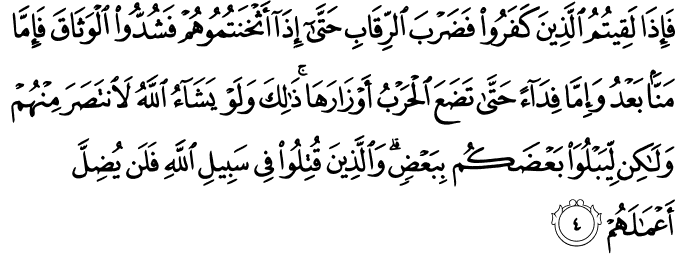
“ So when you meet those who disbelieve [in battle], strike [their] necks until, when you have inflicted slaughter upon them, then secure their bonds, and either [confer] favor afterwards or ransom [them] until the war lays down its burdens. That [is the command]. And if Allah had willed, He could have taken vengeance upon them [Himself], but [He ordered armed struggle] to test some of you by means of others. And those who are killed in the cause of Allah - never will He waste their deeds.”

8:37 
8:37“Fight in the way of Allah those who fight you but do not transgress. Indeed. Allah does not like transgressors.”

   There are also many verses in which God describes the hell-fire in details and depicts the excruciating pain and punishments that await his enemies after life.  

   In order to understand this, we have to start with the necessity of a reward and punishment systems. If creation and if life is purposeful, which is as stated in the following verse, then life has to have a worthwhile gain for everyone who is going through this journey.

16:3
16:3   "He created the heavens and earth in truth. High is He above what they associate with Him."

  
    Life is only meaningful and worth living if we consider it a learning experience as a whole. In truth, all the pain and joy of life leave us with nothing but a spiritual perception that would either enrich our understanding of life or denies the lesson we were supposed to learn from the situation.  We can all imagine a scenario, for example, in which a child never leaves his mom going to a pre-school because it is a very unpleasant for the child for a while until he or she get used to the new learning environment.    In the same way, we may have seen how bizarre it is if an adult person would take a dull toy as serious as a child.  He might be considered retarded which means not intellectually grown to the age.  To a good extent, these two cases represent the essence of the whole life, we are supposed to move on from one stage of learning to another in a way that looks painful and unpleasant to give us our earned gains for more precious ones in the next stage. 

   I have to emphasize the fact that although the life experiences  we all go through is more or less the same for everyone, our personal perceptions from the same events are not.    That is actually the main reason ,in my view, we end up with different beliefs and accordingly different actions which lead us to far apart personalities.   In short, the higher the rewards of an educational system, the higher the motivation for the learners to endure the hard work.  That is perhaps why God says "I have created man in hardship."

90:4
90:4
“We have certainly created man into hardship.”


   It has been clearly stated in Quran in different occasions that it is very challenging for human to overcome its natural desires and go beyond a physical world while apparently he is not equipped with more than material means.  That is to say, seeing the unseen by the eyes that we apparently lack and believing in a cause for the whole cosmos and only in the one who does not have any cause himself unlike all human’s experiences in the material world.  This is evidently unlikely for humans as testified by the angels whom were informed by God of his intention to create man.   We can therefore, say such challenge does deserve rewards and considering the hardship it is fair to expect substantial gains out of this life.  

Now that we have established with the necessity of  lucrative rewards for the good learners in the school of life, we are faced with two choices for the non-learner who deny the light of learning and fight with it with all their means, who destroy the schools and kill the teachers and so on. (not those who are not capable of learning and especial needs are well respected by God). The first option is to be lenient in consequences and overlooking their harmful actions hoping that it will make the wrongdoers come back and undergo the unpleasant change growing toward light.   

Considering the nature of humans on one hand and the deceptive superficial joy embedded in worldly gains on the other hand, it would ,most likely, incline all pupils to incline toward the short term benefits rather than long term rewards. 

One can argue that this is already the way life looks like to most people.  While this view my be corroborated by Quran too, I believe, if the rewards and punishments are not designed equally, it will be just and will be conflicting with the freedom of choice as we would be influenced toward one or the other. I believe, God has explicitly clarified the consequences of our actions and has let us decided on our fate freely, which is the only way that such rewards would make sense.   

What is most interesting about God’s system of punishment, nevertheless, is the door of repent which has been repeatedly emphasized in Quran.  That is the possibility of being saved despite a sinful life and in spite of being a lifelong wicked person if we turn our heart to God.  This is a unique opportunity available throughout our journey and it is exclusively found in God’s educational system.

If we would find the above reasoning convincing for afterlife or for long term benefits in this life , we are left with skepticism over the way God deals with his adversaries in battlefronts when they have started a war. While it is true that the concerning verses sound unforgiving, we have to realize that, in reality, no nice word or act of kindness can change the determination of an evil worrier who is fighting for the immediate material gains of the world.  It is only when they feel dominated they get a chance to listen to their heart.

 Not too long ago, the world witnessed the Second World War which led to the loss of life of 50-60 million people and destruction of most of the civilized world at the time.  I believe, it was ended because the initiators of war felt defeated and felt inferior, otherwise it would have continued for much longer time.   In other words, what made them change their mind clearly was the harsh confrontation of other nations including the rightful conventional combats and the wrongful use of nuclear weapons over Japan.

2:251

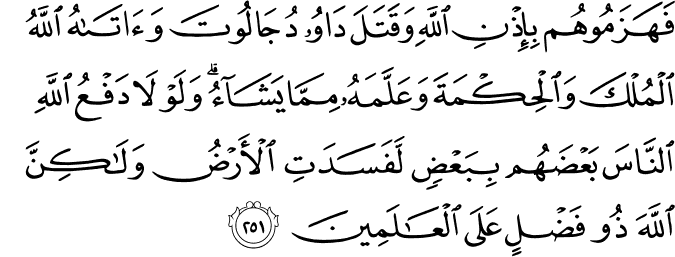
2:251“So they defeated them by permission of Allah , and David killed Goliath, and Allah gave him the kingship and prophethood and taught him from that which He willed. And if it were not for Allah defeating [some] people by means of others, the earth would have been corrupted, but Allah is full of bounty to the worlds.”


                                                                     صدق الله العلي العظيم

Quran quotes from www.Quran.com

Tuesday, February 24, 2015

Heart is the Source of Truth

    I used to think that it is only my opinion to think of some people as if they have been in touch with the truth more than others.  These individuals always appeared to me as if they have sat with the ultimate source of light and their faces have become radiant as a result.  Until I heard same words from the lady in the following YouTube video who is interviewing Ahmad Deedat, then I noticed it is a universal feeling just like the sense of beauty.   


    I am not a fan of debates generally as I am not sure if arguing would ever touch any one's heart.   On the contrary, debates usually hurt the other side and it is a battle that has to have a winner at the price of some one else being the loser.   Nevertheless, I deeply admire Ahmad Deedat (God bless his soul) mainly because I find him motivated purely for God, in the talks that I have seen from him.  In other words he is doing what he does out of love of God which is "Tagva".  

   That said, it does not mean that whatever he says is always right.  You don't have to be perfect to walk, or while walking, the path of God but if you keep walking that way you get closer and closer to perfection. As a result you get to see more of the light and consequently, your heart reflects more of the original light to others.  

    Ahmad Deadat to me also represent a perfect example of how our heart can be the prime source of our knowledge and how it can lead us to the truth.   

    Last but not least, Ahmad Deadat's legacy is an outstanding  proof of Quranic concept that everyone can find the truth regardless of his or her physical/ historical profile.  That is to say, it does not matter what color our skin is, or what hardships we have gone through in the past.  All matters, in deed, is our heart and if we can fill it in with the love of God.