Friday, April 22, 2016

Why Quran 's text is protected ?


To a believer it is a basic fact that the original Arabic text of Quran has not been changed since it has been written about 14 centuries ago.  This is itself an undeniable miracle of Quran if we are willing to open our heart to it.  Miracles are to increase our belief in God which is the ultimate unseen truth of the world. In that sense, Quran itself corroborates this miracle in 15:9:


بسم الله الرحمن الرحيم

انا نحن نزلنا الذكر وانا له لحافظون

"Indeed, it is We who sent down the Qur'an and indeed, We will be its guardian."
As it is clear by now, the propose of this post is not to prove that Quran has remained unchanged  over time.  Instead, I would like to draw your attention to why it is so.  Why possibly God has intended to protect this text unlike the previous ones.  Needless to say, it is only God who knows the real purpose but as it is the case through the Quran we can get a idea by looking at the facts with making a judgement through our hear applying the highest degree of honesty we can find inside our self.    

Basically if we try to take this approach in understanding Quran, in that we are not trying to prove anything to anyone, and only for the benefit of our own, we would naturally try to be our most honest with ourselves.  I truly believe that if all the facts are presented to our heart and all the potential biases such as fame, money or power are removed, our heart is absolutely capable of forming the right judgement especially in terms of good or bad, right or wrong, true or false, love or hate and all the metaphysical matters which are beyond the reach of our rational mind. 

That said, I would wonder how we can make sense about  this property of Quran.  One of the reasonable  hypothesis I heard is since Quran outlines the fundamental metaphysical laws of the world which have been and will be true forever, it does not need any change as the most fundamental principals of the world will not change.  

I believe what makes more sense however, is the fact that Quran appears to be an on going conversation between God and human. That is to say,  every one can potentially find himself the one who is addressed in Quran directly.  Basically, it appears that hesitations, questions and thinking process of Abraham, Noha, Moses or all the others are the same for all us if we would be willing to seriously make sense of our lives. 

Yet it is not only Quran's life changing stories of the past that are amazing, but also its incredible level of customization in addressing our personalized unique situation makes Quran a live conversation.  It may not be easy to prove that Quran is , in fact, alive and ongoing publicly since we are talking about individual circumstances that may not be a concern for others but in our personal lives they are extremely important and real.   

So I would invite everyone reading this to check this for yourself.  I invite you to engage a conversation with God directly by asking something that you have been struggling with for a long time, something that you have been thinking that will reveal more of God to you, something that if clarified would change your life, something you long for and wait for the answer to come to you either in context of a specific verse of Quran or indirectly through a clarification or inspiration that you will feel it in your heart which will settle your worries and gets you out of that situation.  The only requirements are being serious about it and being absolutely honest with yourself. 

It would be great to hear your experiences by replying to this post. 

Last but not least, while recognizing Quran as a live personalized conversation will help us in our lives, it does not answer the question of why God did not protect the previous scriptures.  What made 1400 years ago different from the prior history of mankind.  This is a question that I have had in mind for sometime and I hope God will let me to the answer if he wishes so. 


Saturday, February 13, 2016

How Far is the Judgment Day?


بسم الله الرحمن الرحيم


   إِنَّ ٱلسَّاعَةَ ءَاتِيَةٌ أَكَادُ أُخۡفِيہَا لِتُجۡزَىٰ كُلُّ نَفۡسِۭ بِمَا تَسۡعَىٰ (20:15)

"Indeed, the Hour is coming - I almost conceal it - so that every soul may be recompensed according to that for which it strives."

ٱقۡتَرَبَتِ ٱلسَّاعَةُ وَٱنشَقَّ ٱلۡقَمَرُ (54:1)

"The Hour has come near, and the moon has split [in two]. "    

إِنَّ ٱللَّهَ عِندَهُ ۥ عِلۡمُ ٱلسَّاعَةِ وَيُنَزِّلُ ٱلۡغَيۡثَ وَيَعۡلَمُ مَا فِى ٱلۡأَرۡحَامِ‌ۖ وَمَا تَدۡرِى
 نَفۡسٌ۬ مَّاذَا تَڪۡسِبُ غَدً۬ا‌ۖ وَمَا تَدۡرِى نَفۡسُۢ بِأَىِّ أَرۡضٍ۬ تَمُوتُ‌ۚ إِنَّ ٱللَّهَ عَلِيمٌ خَبِيرُ (31:34)                     

"Indeed, Allah [alone] has knowledge of the Hour and sends down the rain and knows what is in the wombs. And no soul perceives what it will earn tomorrow, and no soul perceives in what land it will die. Indeed, Allah is Knowing and Acquainted."

  صدق الله العلي العظيم


I have recently seen some Islamic scholars' video lectures in that they are trying to predict a specific time when they believe according to the sings implied in Quran the world will end  and consequently the resurrection day and judgement day will follow soon after. 

This is while according to the verse 20:15 above, it is only God who knows when the world will end and he has purposefully hidden this event until it is very close and there are obvious sings such as the moon being split into halves (verse 54:1) and so on.  Basically if people had a way to discover it then it would defeat its purpose of only believers in "Ghaib" unseen would be rewarded.  Only the true believers  in God who have lived their lives for God doing good deeds out of their faith  will survive that day. 

That said, we can look at the world's end-time  in a practical way.  That is, end of the world may either  happen in our life time, which one would reasonably consider it unlikely as our mind tells us that if it has not happened in thousand years already it is unlikely to happen soon, or alternatively our personal world will end by our death which is undeniably coming and will connect us directly to resurrection day. 

The question would now be if anyone can predict his death. The verse (31:34) states that it is again only God who knows where and when we will dye.  This time however, we can form at least a time frame in our mind as to the latest time when we will move to the other world.   That is to say, usually we are about our thirties and forties by the time we take these thoughts seriously in our life.  By then, we will be left with the remaining of average life expectancy in the particular place we are living in, which may vary from another 30 or 40 years later. 

In other words, by the time we potentially take our next life to our heart we have gone already half way.  Looking back at our first half of life on the Earth, it appears to us just like yesterday.  By the same token, perhaps we can come to the belief that our departure from the world would not be too long from now, if not tomorrow.   That is how we realize by our heart that : "Indeed, the Hour is coming".

Sunday, December 27, 2015

The Mysterious Story of Abraham's Sacrificing his son - Part 2


The three remaining questions from last post were:
  1. Why Abraham is so highly spoken of throughout Quran to the degree that he is called "friend of God"?
  2. What is the impact of Abraham on the world after him?
  3. What kind of relationship with God is illustrated in Quran by the story of Abraham's life?
1. It appears to me that the main events in Abraham's life has one thing in common which makes him so special before God.  I believe that is his total devotion to God throughout his life as far as it is narrated in Quran.  He has proven his complete surrender to God by following God's orders despite all the odds. That is to say, he surrendered himself to the fire they had thrown him in as the punishment for shattering their idols into pieces.  Abraham left his second wife "Hajar" and his son "Esmaeel" in the desert of Mecca as God had commanded him, despite the extremely harsh conditions of the terrain he left them in, with no foods and water.  The action of sacrificing his son had also the same intention although it was not commanded by God and was stopped by God. Same was true about building the "Kabaa" (God's home) in a place that was uninhabitable at the time.

Quran has not narrated the story of Abraham's life from the beginning to the end, as we can see throughout Quran it only states the highlights or the most important points of an event skipping over the details.  Perhaps we can say that Abraham like any other human being was living a normal life and he was learning by trial and errors like all of us except the fact that he has made such a critical and determinant choices to surrender to God's command in the events that has been told in Quran.  In other words, we have been given our life time to try and learn for ourselves until we spiritually ripe enough to the degree when we can surrender ourselves to God with such a pure devotion as Abraham's ,when we are tested in certain occasions.  This implies we can all walk the path Abraham did, although I do not mean we can end up being a prophet or being so special to God.  Nonetheless, everyone can have a unique relationship to God which I believe is the underlying concept of God's being "Rahim", as explained in early posts. 

Speaking practically, we can constantly try to align our intention of doing the mundane tasks with God's satisfaction as we perceive so.  Yet there will be a few occasions in everyone's life when making a choice for the sake of God will appear against the norms, against our personal interests and perhaps could be very costly to us.   I believe those are the decisions that will fundamentally affect our life afterwards.  By the way of example, if we found ourself in an unhappy marriage already with a child or with children and we feel like God would be happier with us if we stay in the marriage mostly because of the kids,  while it is clear to us that we can have a better life if separated,   this decisions can tremendously affect the future life of the children and may bear an unexpected fruit which will worth all the hardship of the long years of patience.   Needless to say, I do not mean that we should stay in a wrong marriage at all costs. 

2. I believe Abraham's surrender to God so purely not only has made him a friend of God, as stated in Quran, but it also has impacted humanity tremendously.  According to Quran in the verses following 37:110 all later prophets' ancestry could be traced back to Abraham trough either "Eshaag" or "Esmaeel".  Therefore, it maybe reasonable to assume that if it wasn't for Abraham mankind might not had the greatest/dearest prophets "Moses", "Jesus" and "Mohammad".   In verse 37:100 Abraham prayed to God to be granted a righteous child and in 3:35-37 "Omran's wife" (Maryam's mother) dedicates her baby to God which led to the birth of Jesus.  

It is fascinating how prayer of a few individuals (other humans) have affected the course of history of humanity so drastically. This is while in the eyes of the praying person God may not have granted him what he/she wished for because mother of Maryam asked for a son but she gave birth to a girl who years later turned out to be the mother of Jesus.   In the same way, it might be faire to say that if Adam's sin in heaven brought his descendants suffering on earth, Abraham's actions resulted in guiding humans to happiness again.   My point is this is potentially the scope of the effects the our relationship with God can bring about. 

3.  I believe Abraham's relationship with God illustrates an ideal way we should connect to God, that is we are to practically commit ourselves to God and do whatever we do in life for him. That is the true meaning of being God's servant (which is not the right word I believe).  We have to conceptualize the image that Quran is depicting from our potential relationship with God and discover what Quran is truly about.  We are to find a word which represents total devotion, which gives one entity priority over all others in our life in practical terms , in our actions not in our words or merely in our feelings. We are here to find out this relationship by trial and error by a learning process of dedicating yourself to different things and beings until we realize there is only one supreme being which is worth sacrificing everything we have for. That is when we fall in the true love which is eternal and will include all the humans' as well. 


Wednesday, December 23, 2015

The Mysterious Story of Abraham Sacrificing His Son


بسم الله الرحمن الرحيم


فلما بلغ معه السعي قال يا بني اني ارى في المنام اني اذبحك فانظر ماذا ترى قال يا ابت افعل ما تؤمر ستجدني ان شاء الله من الصابرين 37:102
"And when he reached with him [the age of] exertion, he said, "O my son, indeed I have seen in a dream that I [must] sacrifice you, so see what you think." He said, "O my father, do as you are commanded. You will find me, if Allah wills, of the steadfast."
فلما اسلما وتله للجبين  37:103
"And when they had both submitted and he put him down upon his forehead,"
وناديناه ان يا ابراهيم  37:104

"We called to him, "O Abraham,"
قد صدقت الرؤيا انا كذلك نجزي المحسنين 37:105

"You have fulfilled the vision." Indeed, We thus reward the doers of good."


ان هذا لهو البلاء المبين 37:106

"Indeed, this was the clear trial."
وفديناه بذبح عظيم  37:107
"And We ransomed him with a great sacrifice,"


وتركنا عليه في الاخرين  37:108
"And We left for him [favorable mention] among later generations:"

سلام على ابراهيم   37:109

"Peace upon Abraham."

كذلك نجزي المحسنين  37:110

"Indeed, We thus reward the doers of good."

   صدق الله العلي العظيم
Quranic Verses from Quran.com


Having read the above verses, there are a number of questions that come to our mind namely:

  1. Is it God who demanded sacrifice of Abraham's son through a dream? 
  2. Why God stopped Abraham ?
  3. What is praised by God on this specific act of Abraham?
  4. Why Abraham is so highly spoken of throughout Quran to the degree that he is called "friend of God"?
  5. What is the impact of Abraham on the world after him?
  6. What kind of relationship with God is illustrated in Quran by the story of Abraham's life?

1.  Based on the other cases in Quran where a dream has been interpreted such as Yusuf's dream, it seems that true dreams are mainly an indication of what is to come in future.  Our personal prophetic dreams, which present clear vision of an upcoming event, corroborate this fact as well. They primarily show the events that are going to happen soon.

I am not sure if there is a concrete evidence in Quran in which God has explicitly given a command to a Prophet through a dream.  On the contrary, I believe "Vahy" meaning God's words (directly or indirectly) to Prophets have always been received in their state of full consciousness.

It also appears that Dreams have something to do with personal desires and conditions. That is  to say, dreams often answer an intention or a question that we have been thinking about for a long time or they address a personal deep concern or emotion.  From this perspective, it can be assumed that Abraham might have been influenced by a tradition of his time when it was common to sacrifice their children for their Gods. Judging from Abraham's life story as narrated by Quran however, we can realize that Abraham was always obsessed with the best he could do for God in the course of his life. Evidently, it is more reasonable to assume that he had believed such sacrifice could be the ultimate deed for God. This motivation as the main source of his dream would be more consistent with his other actions such as leaving his second wife with the new born son in a desert against all the odds, as instructed by God, where was later called Mecca the holiest place on earth for ever after.

That said, we can come to the belief that Abraham's dream was not a clear instruction from God asking Abraham's to sacrifice his son.   I have seen the interpretations which take the son's words "do as you are commanded" in verse 102 as the proof for considering the sacrifice a command from God. I am not sure if that is entirely the case. In my opinion, it only shows the son had surrendered himself to God and he was willing to give his life for God if it is demanded.

2 & 3. If the sacrifice was God's command, there was no reason for him to stop Abraham.  In verse 104 it is clearly stated that God calls upon Abraham and then in 105 God tells him "You have fulfilled the vision"   and he was told this not in a dream.

One would argue that verse 106 could be the evidence to the contrary. "Indeed, this was the clear trial."     The answer to this argument is hidden in the previous verse 105: "You have fulfilled the vision." Indeed, We thus reward the doers of good."   What is the good action being rewarded by God, if it is the sacrifice itself it is not done.  What is so worthy of God's praise is infact, the Abraham's sacrifice of his dearest asset in life for God.  To give a priority to God over all his interests even if it is the life of his beloved son who is given to him after years of praying and expectations. Especially a son whose birth itself was a miracle because of the age of Abraham's wife, according to earlier verses.

We can therefore, come to the conclusion that God had never intended for Abraham's to actually kill his son with his own hand but to only test him indirectly to choose between his interests  and God's, as perceived by Abraham from his dream, definitely not based on God's command.

Most importantly, I believe the message of this event for our time is the fact that we are not allowed to hurt an innocent person with the intention of doing something for God in order to purify our soul or get closer to God.  This is a clear contradiction we can see today in many evil actions that are done in the name of religion , Islam in particular. Harming innocent man, women or children, in anyway, regardless of their faith or race is a satanic criminal act and can not be based on a true religion and its potential justification is only a distortion of truth.

I would like to emphasize that ,based on these verses of Quran, no matter how devoted we believe our action is to God, we are not allowed to commit any immoral action.  If we are to follow Abraham's footsteps look how humanly he has discussed his frustration with his son and has done noting without his consent (102).


I will try to answer the remaining  3 questions in the next post, God willing.


Wednesday, September 9, 2015

Does "Zaraba" Mean Hitting by Hand in Verse 4:34 ?


One of the controversial verses of Quran is certainly the verse 34 of Al-Nissa, which, seemingly, appears to suggest using physical violence against women who are in an emotional state of disobedience to their spouse.    


                                                                 بسم الله الرحمن الرحيم

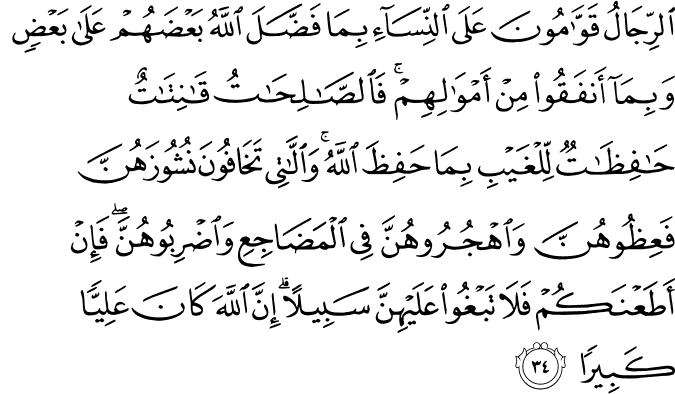
4:34

4:34"Men are in charge of women by what Allah has given one over the other and what they spend  from their wealth. So righteous women are devoutly obedient, guarding in  absence what Allah would have them guard. But those [wives] from whom you fear arrogance - [first] advise them; [then if they persist], forsake them in bed; and [finally], strike them. But if they obey you [once more], seek no means against them. Indeed, Allah is ever Exalted and Grand."

                                                                صدق الله العلي العظيم


The main idea of this verse, I believe,  is to determine the relationship between the men and women by explaining that men have dominance over women due to the advantages given to them by God and due to the fact that men support women financially. 

Having lived in Canada for some years now, I fully appreciate the significance of feminism (meaning equal rights and opportunities) in the western world as I don't find it contradictory to the fact that women and men have fundamental differences in their nature, which lead to varied needs and dependencies. Historically, women have always lived under the umbrella of men's protection in terms of their security, safety and financial needs. This dependency becomes particularly evident at time of wars, dealing with environmental risks as well as making a living. Although it is true that today women can be financially independent in many countries and they are even more successful than men, most women feel more comfortable with the idea of being financially provided for. In other words, Women, in most cases, do not prefer to earn a livelihood if they do not have to, self-improvement aspects of a job aside. 

In comparison, while women seem to be psychologically dependent on men, men are physiologically relying on women. That is why we can see more single moms than single fathers. Women show a tendency to replace their spouse with their children. Judging from life experience, I believe men and women equally need the opposite gender to evolve to their full capacity that is embedded in every human nature. 

That said, it appears men have an innate feature that when they provide for a woman they expect an exclusive commitment in return with regard to their sexual and physical intimacy needs. That is to say, men by their nature assume a dominance over their mate.  This serves as a foundation for their entire psyche and of course it works equally the same for women as well. The significance of this psychological interdependence becomes clear when it is shaken by one side cheating over the other be it in a marriage or not. The extreme reactions that most people show in response to these situations range from personal emotional drama to committing a serious crime against the partner. There are everyday news and movies to evidence this fact of life. 

The main controversy however, comes later in this verse where it is stated that when a woman shows disrespect and unwillingness toward her partner (reason is unknown) then Quran instructs a sequence of actions which starts with talking her off the mood, then if that doesn't work, abandoning her in bed is the next step and finally if either one does not help the situation it appears that Quran says striking is an option which means hitting by hand. The verse further emphasizes that when the woman seems to behave properly there should be no further follow up on this matter. 

I personally have serious reservations to take the Arabic verb "Zaraba" as hitting in this context. That is mainly because we can think of quite a number of arguments against this interpretation. Namely, the woman may have rightfully some reasons not to be willing toward her partner. Secondly, I doubt if physical violence could help anyone's temperament in such situation. And thirdly, it is not conceivable to set a punishment without exact details that would be unprecedented in Quran. Lastly, if physical supremacy of men is meant to be the final solution, it will be contradictory to the next verse 4:35 in which a biding arbitration by a representative from each side is ordered as the ultimate resort to settle lasting family disputes. 

Searching Quran for the different meanings of "Zaraba" we come across to three distinct applications. 

  1. Meaning to give an example in verses : 2:26, 13:17, 14:24, 14:45, 16:75, 16:76,........
  2. Meaning to hit by hand in verses : 7:60, 7:160, 37;93, 38:44, 38:44.
  3. Meaning figuratively to travel, to cast, to cover in verses : 2;273, 3:156, 4;101, 5;106, 20:77, 18:11, 2:61, 43:17 and 43:58. 

It is a huge relief to see this verb is used to mean other than hitting. That is why I am inclined to believe that "Zaraba" in this case is meant to travel or to leave the woman alone which I think in real life is the most practical temporary remedy for this situation. I admit however, that we can not find a similar context in Quran in which "Zaraba" is explicitly used to mean moving out. Nevertheless, we can always ask ourselves which meaning is closer to God's satisfaction. This way, I will have no hesitation that interpreting "Zaraba" figuratively to mean travel or move out will be the best fit in this case. 

At the end of the day, we can always perceive Quran in line with God's satisfaction or we can read it word for word to support the desires of our ego and to pursue our personal interests in the name of religion. Today, a suicide-bomber or an ISIS Jihadi. for example, would claim that he is fighting for God, to the best of his knowledge.  The truth of the matter is. there is only a fine line between the two intentions which can only be seen in the light of a pure and guided heart.  Nevertheless, once these intents are materialised, their outcome are incomparable and easy to differentiate. 

Finally, this discussion may also demonstrate the fact that in the absence of the Prophet, the only legitimate authority for interpretation of Quran, we are left with hadith and personal inspiration, both of which seem to be relative and indefinite despite being extremely helpful. This will lead us to a very practical conclusion that any human understanding of holy scriptures are merely personal understandings which can not be regarded as God's orders. It does not matter whether it is based on years of studying religious texts or if it is based on personal inspiration. 


Saturday, August 22, 2015

The Metaphysical Side of Human Being?

Firstly, everyday when we look at ourselves in the mirror the first thought comes to mind is "this is certainly not me".  It is true however, that we feel we are looking at our body as a possession which implies that there is a real me beyond the image in the mirror.  We can hardly deny this feeling that has existed with us ever since we have reflected on this matter. 

Secondly,  when we are asleep whether over nighttime or when we are unconscious due to a medical condition, we are not expected to be responsive and reactive to our environment.  In other words, our consciousness seems to be what we are identified with, whoever we are.  Human character, personality and temperament can not be attributed to our body.  

Thirdly, as Rumi said, when some one is dead his or her loved ones do not consider the remaining body to be their love.  Evidently, it is not the visible body that we love. The dead person is considered gone while the physical body is still present. 

These classical examples from daily life represent a profound truth about the nature of our entity. They lead us to believe that the core of our existence ,in fact, lies in the supernatural side of us that exists in an invisible dimension to our eyes.  

Let's have a look at a few of the related Quranic verses which hopefully will guide us to form an idea of the true nature of human being beyond a body of flesh and bone.


                                                            بسم الله الرحمن الرحيم

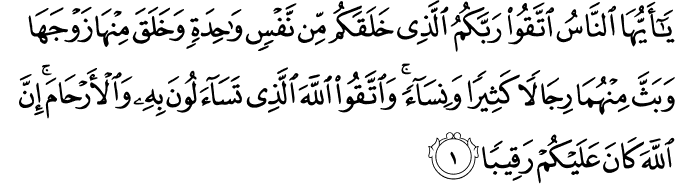
4:14:1
"O mankind, fear your Lord, who created you from one soul and created from it its mate and dispersed from both of them many men and women. And fear Allah , through whom you ask one another, and the wombs. Indeed Allah is ever, over you, an Observer.

21:35
21:35

"Every soul will taste death. And We test you with evil and with good as trial; and to Us you will be returned."

14:51
14:51
"So that Allah will recompense every soul for what it earned. Indeed, Allah is swift in account."

91:791:7
"And [by] the soul and He who proportioned it"

91:891:8

"And inspired it its wickedness and its righteousness,"

91:9
91:9

"He has succeeded who purifies it,"

91:1091:10

"And he has failed who instills it ."

50:1650:16
"And We have already created man and know what his soul whispers to him, and We are closer to him than [his] jugular vein"

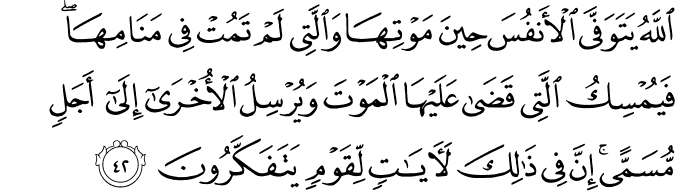
39:42

39:42"Allah takes the souls at the time of their death, and those that do not die [He takes] during their sleep. Then He keeps those for which He has decreed death and releases the others for a specified term. Indeed in that are signs for a people who give thought."

38:72

38:72"So when I have proportioned him and breathed into him of My [created] soul, then fall down to him in prostration."

  صدق الله العلي العظيم
 
I would like to begin by clarifying that the purpose of this writing is not to find out the way and the sequence in which the first human was created but it has the intention to put together different pieces of underlying information in the above messages in order to form an understanding of the metaphysical side of human being according to the Quranic view.

Clearly, from 4:1 we can understand that all humans were created from the same essence " Nafs" as it is called in Quranic language.  In most translations "Nafs" has been turned to "soul" which I am not sure if it is the right counter word in English since soul is used in the last verse 38:72 in its distinguished context.  For the lack of a better term, we should stick to the original word "Nafs" for now.

   Over the verses that follows, "Nafs" and its functions is described with some details:
  • 21:35 states the mortality of "Nafs". 
  • 14:51 Every "Nafs" will face the consequence of what it has achieved. This concept will pave the way to understand hellfire as an outcome rather than punishment in the afterlife. Furthermore, it implies that our actions and our choices impact our "Nafs" permanently. That is, in the course of our lifetime we will gradually shape our "Nafs" into its final status before we leave this world.  
  • 91:7 God has made the "Nafs".
  • 91:8 God speaks to us through "Nafs" which is the base for our internal moral judgments. "Nafs" is therefore, our source of inspiration and is our communication channel with God in which our ethical feelings are formed. Depending on God's inspiration we will feel guilty, troubled, or conversely happy and content.  Human conscience as known today is probably the perfect fit for this Quranic description. 
  • 91:9 The success of our life in this world is determined by the final status of our "Nafs".  In this sense, the highest achievement of our life time is to purify our "Nafs" from all voices but God's.  
  • 91:10  The real failure in life, on the other hand, is to completely lose our "Nafs" to sins and to Satan in general, as opposed to God. 

Before proceeding with last three verses we need to establish what is "Nafs" as far as we can read between the lines.  From the explained verses, we can infer that "Nafs" is the common core of all humans with inherently the same nature which gives everyone an equal potential to prosper spiritually.  Additionally, everyone is given a pre-determined limited time to learn from the laboratory of life by freely experiencing wicked and righteous actions.  We are given the freewill to choose between engaging devil and divine to see how they affect our happiness in the short and in the long term.  The choices we make in our life will reflect on our "Nafs" and will either illuminate it or darken it steadily so that "Nafs" itself will represent the result of our life journey.

An enlightened "Nafs" has overcome the temptations of Satan and has grown under the light of God's inspiration. It has learned and practiced God's names and his qualities. Such guided "Nafs" finds peace and happiness in following God's light in terms of differentiating good from bad or right from wrong in daily life's judgments and actions.  It glows with light and emits love to all others in his or her proximity.  This perfected "Nafs" has been in touch with truth most of his lifetime in this world so when it enters the next life it is well suited to live in harmony with  the world of pure, unveiled 
truth. That is why, it can enter the heaven which was tailored to its exact status so that "Nafs" will continue to further learn and thrive in its ever continued growth toward God.

In Contrast, the "Nafs" that has followed Satan's voice and has engaged in evil actions will get darker and darker and loses its functionality and its capability to hear the inspiration of God.  As a result, such "Nafs" will deny sings of God, which work as guidelines to the truth, to the degree that it will entirely lose its ability to see the reality of life and to grow out of the basic lessons of this world. Having turned to a senseless stone at the end, such "Nafs" has to go through the hard way in afterlife to learn what it has missed in the first life.  As a matter of fact, whenever we humans stubbornly resist learning a fact of life we end up with learning it the hard way.  That is, through a painful and forceful process.  In other words, if we choose to willingingly and knowingly disapprove the ultimate truth of the world, which is God, we will virtually turn our "Nafs" to a stone. Then, perhaps the only cure would be to melt down this hardened "Nafs" by fire in order to turn it back to a pulpy flexible core that will regain its original features including its learning potentials. This way, the restored "Nafs" can 
appreciate and follow the light of God to move out of that hard learning phase of hell.

Summarizing the functions and features of "Nafs", it is the source of inspiration equally from God and from Satan.  "Nafs" initially is created in an equilibrium between its inclinations toward goodness and wickedness until we prefer one over the other.  Otherwise, the freedom of choice would not make sense.  That is to say, if one force was overriding the other we would have felt powerless and predetermined, which is certainly not the case.  Our thoughts and actions will nourish our "Nafs" so that it will become the product of our life.  It is the only saving that we will transfer to the next life and its final status will entitle us to the next learning setup which hopely will be heaven for all us.

That said, "Nafs" is not the only component of our supernatural being.  The verse 50:16 explicitly stats that  "And We have already created man and know what his soul whispers to him,...."  which implies that it is not the "Nafs" who is in control.   "Nafs" too works as possession of our true self.  In fact, the nature of our entity who is in charge of all aspects of our being is mentioned in the beautiful and  extremely important verse 38:72;  "So when I have proportioned him and breathed into him of My [created] soul, then fall down to him in prostration."  When God was done with the making of first human, that is creating from clay, shaping and making the "Nafs" he has blown into us from his holy spirit.   This is the missing piece of our puzzle and the most precious one. 

In truth, the decision maker and the owner of our the physical body as well as the metaphysical part "Nafs", is our "Soul", which is of the spirit of God ruling over both the visible and the invisible side of us.   Our Godly soul is the ultimate self. It is the eternal essence of us which inherently has the potentials of God on a human scale. Although it is like a drop of an ocean, it has the similar qualities and properties.  It is the will, the determination that drives us through life. It is the one who picks from the inspirations and temptations we receive through our "Nafs".  It is the intellect and the spirit that resides on the invisible dimension of our existence. It is the driving force that is subtle yet in complete control of all our physical body similar to God's relationship with the material world. "Mind" is probably, the equivalent modern day term for soul. our supernatural entity. 


Having looked at the features and functionality of  "Nafs" and "Soul", we may recognize that "Nafs" is very much analogues with our heart and likewise "Soul" is reminiscent of our brain.  That is to say, as "Nafs" presents the divine and the devilish inspirations to our mind so does our heart pumps up the bright and dark blood to brain and throughout our body. We may further conclude that it appears as if  our physical body, our heart and brain in particular, is a material representation of our metaphysical side.  This makes sense especially when we take the symmetrical property of all creatures into account. 


At the end, as much as the above revelations fascinate us, they lead us to more challenging questions 

Does this metaphysical side exist in all creatures ?  
To what extent our "Nafs" is influenced by our parents' considering that we inherit their gens ?  


Wednesday, August 12, 2015

The Amazing Story of Human Creation in Quran Might Be the Answer to the Evolutionists as well.


  Among the verses of Quran in which the creation of human is narrated, verses 30 to 34 of Al-Bagarah (2) are quite unique.  In a fascinating comparison of Adam with angels, essentially, God reveals the fundamental supremacy of human nature that qualifies him to be God's successive authority on earth.  One would wonder what the distinguishing feature of man is that has made him even superior to angels?


بسم الله الرحمن الرحيم

2-30
2:30"And, when your Lord said to the angels, "Indeed, I will make upon the earth a successive authority." They said, "Will You place upon it one who causes corruption therein and sheds blood, while we declare Your praise and sanctify You?" Allah said, "Indeed, I know that which you do not know."

2-31
2:31
"And He taught Adam the names - all of them. Then He showed them to the angels and said, "Inform Me of the names of these, if you are truthful."

2-32
2:32
"They said, "Exalted are You; we have no knowledge except what You have taught us. Indeed, it is You who is the Knowing, the Wise."

2-33
2:33
"He said, "O Adam, inform them of their names." And when he had informed them of their names, He said, "Did I not tell you that I know the unseen [aspects] of the heavens and the earth? And I know what you reveal and what you have concealed."


2-34
2:34
"And [mention] when We said to the angels, "Prostrate before Adam"; so they prostrated, except for Iblees. He refused and was arrogant and became of the disbelievers.

  صدق الله العلي العظيم
From www.Quran.com


    Perhaps judging from the animals' life previously existed on earth, angles had reasons to believe that any other new creature in the material world would necessarily involve killing and blood shed over dominance of earth's resources for survival.  This actually seems to be true for the most part of the history of human's life too, if we were to dismiss the intellectual and spiritual growth of mankind. God, however, proves them wrong by putting Adam and angles to a test which was to learn the names. And the result ,according to the verses 30&31 above, is that Adam learned the names but angles did not.  

    Considering the fact that nature and details of the names have not been specified (in my opinion because it doesn't matter actually), the remarkable revelation of these verses is to demonstrate the unique learning capability of humankind in comparison with the best of creation that are angeles.  This contrast could not have been made more explicit.  Learning ability, to the extent that humans possess,  is indeed the main distinguishing feature that superiorize us over all other beings in the seen and in the the unseen world. 

    The prominent counter argument would be the limited learning capacity we can see in most animals in terms of being trained to behave in a certain way in exchange for food or other treats. "Conditioning" is probably the name of this type of learning.  In this sense perhaps, we can encapsulate the evolution of all natural creatures in a form of conditioning as well.  It is a well known fact that from the smallest to the largest live organisms learn from their natural habitat how to improve themselves in order  to survive in competition with other species. This process of gradual and subtle improvements towards perfection over millions of years, natural evolution/selection, is basically what has derived all creatures including mankind from a single cell or gen all the way up to their current shape and form, in the evolutionist point of view.  

   While it is true that all living creatures are equipped with some degree of learning talent, the evolutionary changes that take place even over a very long period of time have never made a fundamental alteration to the nature of that creature.  They are always imposed by the survivability principle with minor scope of refinement.  Animals ,for example, may learn to change the color of their skin in order to act as camouflage to hide from their predators or from  their prey. Please check out the link below to see unbelievable examples of such cases.  Yet, it is highly unlikely that a crawling Gecko for instance, learns to fly or live in water no mater how long he is given to evolve.  
http://www.boredpanda.com/animal-camouflage/

   Learning process in human on the other hand, can be summarized as an intellectual and spiritual transformation from the few known facts we know about a question in our mind to the unknown answers.  In other words, it is a metaphysical journey from obvious, from apparent and from the seen world to the unseen world with often times unpredictable results.  History is the best display of the range of astonishing learning of mankind from the beginning of time to now.  By the way of example, math starts with defining numbers as its basic foundation and then simple operations such as addition, subtraction and multiplication follow.  All this elementary findings are easily verifiable by our 5 senses.  From this simplicity it builds up its complication to entirely theoretical and abstract concepts such as calculus.  Similarly, the same escalation of complexity can be traced in chemistry, physics and in all other branches of natural science.  

    Interestingly enough, when it comes to an absolutely abstract subject namely philosophy, it appears that the same chain of thoughts take place.  That is to say, we start with an undeniable fact like, "I think so I am" as Descarte said, and then develop our metaphysical principles on this base.  

     Even more interestingly, the impact of acquisition of knowledge on humans is not limited to mental faculty but it will also result in an spiritual transformation. That is, if you learn math long enough it becomes your second nature and you become a mathematician which is a name given to a person with certain cognitive skills who has developed capabilities in solving mathematical problems. The same is true about becoming a physicist, a chemist, a physician or a philosopher for that matter. They develop specific traits and characteristics that are associated with each profession.  In reality, their personality has changed or to be exact, their mind has evolved to a superior entity that they were not before while their physical appearance has not altered at all.  By the same token, we can fly as a bird or we can swim as a fish without physically transforming to one.  We become a driver when driving becomes our second nature.  We become a foreign language speaker particularly when the names of that language become our second nature. Through these examples we can clearly see that we convert to what we truly learn. 

     Contrary to all other creatures on earth, human evolution is in truth not confined to the material world.  We learn about kindness and charity to others by practicing these names and once we have experienced these qualities long enough then we become kind and generous. This is definitely an spiritual elevation as acquiring these characteristics make us enjoy life more deeply and we will feel more peaceful internally than ever before. We learn about forgiveness by being forgiving and above all, we learn about love by loving others.  

    Much to the surprise of angles, humans can learn the names on earth which involves mud and blood.  Nevertheless, we are capable of transcending beyond our material nature and reach for the stars well above the reach of all angles.  That is what God has made us for and that is how mankind was created in the first place.  The inevitable spiritual transformation occur either through the earthly experiences of  life or through the hard way of afterlife for some. 

   In short, the above verses explains the Quranic view on creation of human.  That is essentially he has been originally designed and created differently from all other beings including all creatures on earth and all the metaphysical ones in heavens. According to Quran, human being came to existence from an smelly mud and has learned some of the names so far, proving to be the second authority on earth.  Since the ultimate attributes belong to God and the ultimate truth is in fact the nature of God, it should be no surprise to perceive humanity as the only creation who is well capable to elevate his spiritual being as close as possible to the characteristics, the names, of God.   This seems to me a convincing understanding of appointing a successive authority on earth as stated in the first verse. 

    I wonder if the Quranic perspective of human evolution is seen in nature besides mankind and if such transformation is ever conceivable as the work of nature for any other creature on earth in the evolutionist view.