Sunday, July 26, 2015

Halal and Haram Foods

   One of the areas where Sharia Laws, which is mostly derived from hadith and tradition, clearly differ from Quran is the definition of Halal foods particularly with regards to the way animals are killed for their meat.   The following is a list of related Quranic verses (as far as I have found) with their English translation.  I have not included the original Arabic words for brevity.


                                                              بسم الله الرحمن الرحيم

2:173
"He has only forbidden to you dead animals, blood, the flesh of swine (pig), and that which has been dedicated to other than Allah . But whoever is forced [by necessity], neither desiring [it] nor transgressing [its limit], there is no sin upon him. Indeed, Allah is Forgiving and Merciful."

5:3
"Prohibited to you are dead animals, blood, the flesh of swine, and that which has been dedicated to other than Allah , and [those animals] killed by strangling or by a violent blow or by a head-long fall or by the goring of horns, and those from which a wild animal has eaten, except what you [are able to] slaughter [before its death], and those which are sacrificed on stone altars, and [prohibited is] that you seek decision through divining arrows. That is grave disobedience. This day those who disbelieve have despaired of [defeating] your religion; so fear them not, but fear Me. This day I have perfected for you your religion and completed My favor upon you and have approved for you Islam as religion. But whoever is forced by severe hunger with no inclination to sin - then indeed, Allah is Forgiving and Merciful."


5:4 
"They ask you, [O Muhammad], what has been made lawful for them. Say, "Lawful for you are [all] good foods and [game caught by] what you have trained of hunting animals which you train as Allah has taught you. So eat of what they catch for you, and mention the name of Allah upon it, and fear Allah ." Indeed, Allah is swift in account."

5:5
"This day [all] good foods have been made lawful, and the food of those who were given the Scripture is lawful for you and your food is lawful for them. And [lawful in marriage are] chaste women from among the believers and chaste women from among those who were given the Scripture before you, when you have given them their due compensation, desiring chastity, not unlawful sexual intercourse or taking [secret] lovers. And whoever denies the faith - his work has become worthless, and he, in the Hereafter, will be among the losers."

5:96
"Lawful to you is gain from the sea and its food as provision for you and the travelers, but forbidden to you is gain from the land as long as you are in the state of ihram. And fear Allah to whom you will be gathered."


6-118
"So eat of that [meat] upon which the name of Allah has been mentioned, if you are believers in His verses."

6-119
"And why should you not eat of that upon which the name of Allah has been mentioned while He has explained in detail to you what He has forbidden you, excepting that to which you are compelled. And indeed do many lead [others] astray through their [own] inclinations without knowledge. Indeed, your Lord - He is most knowing of the transgressors."

6-121
"And do not eat of that upon which the name of Allah has not been mentioned, for indeed, it is grave disobedience. And indeed do the devils inspire their allies [among men] to dispute with you. And if you were to obey them, indeed, you would be associators [of others with Him]."

6-142
"And of the grazing livestock are carriers [of burdens] and those [too] small. Eat of what Allah has provided for you and do not follow the footsteps of Satan. Indeed, he is to you a clear enemy."

6-145
"Say, "I do not find within that which was revealed to me [anything] forbidden to one who would eat it unless it be a dead animal or blood spilled out or the flesh of swine - for indeed, it is impure - or it be [that slaughtered in] disobedience, dedicated to other than Allah . But whoever is forced [by necessity], neither desiring [it] nor transgressing [its limit], then indeed, your Lord is Forgiving and Merciful."

16:115
"He has only forbidden to you dead animals, blood, the flesh of swine, and that which has been dedicated to other than Allah . But whoever is forced [by necessity], neither desiring [it] nor transgressing [its limit] - then indeed, Allah is Forgiving and Merciful."

   صدق الله العلي العظيم


Translations are quoted from www.Quran.com
 
      I often find it hard to write an interpretation for verses of Quran because it feels to me as if I am trying to shine candle light on something which is already under dazzling sun light.  Our explanation seem to be like the fainting lights of a candle in the sun shine of God's words. Sometimes, it appears that God is too evident and too apparent to be conscious of, in the sense that water is invisible for a fish or similarly perhaps air to us. We only become aware of them by experiencing their absence. That is to say, we appreciate daylight by night so does a fish appreciate water by going out of it. Could this be true about our freedom to sin against God too? Could this be the reason for God to let the Satan deviates from his instruction in the first place?  I believe it could. 
 
    Back to the definition of Halal food, it has been clearly specified in the first verse above (2:173) that "HARAM" includes dead animals, blood, pork as well as any animal that has been killed as a sacrifice for other than God. In other words, only if any animal is slaughtered in dedication to (or in the name of ) anybody or anything other than God, then it is "Haram", otherwise, it is not.   More interestingly, the very same details and explanation has been repeated in a number of other verses including 16:115 which is the last one in Quran concerning this matter. 

    From this verse we can solidly deduct that if at the slaughter of an animal no name is mentioned and it is not a sacrifice dedicated to other than God, its meat is "HALAL" as clarified in quite a few places to avoid any misunderstanding. On the other hand, in verse 6-119 it is emphasized that the opposite is not true.  That is, if God is named at slaughter that food is absolutely "Halal". 

      Going through later verses above, one may argue that 6-121 evidences quite the contrary: "And do not eat of that upon which the name of Allah has not been mentioned,.... .  It is said that one of the miracles of Quran is that the apparently conflicting verses are clarified by another verse.  In this case, verse 5:4 may be a proof to such supernatural aspect of this holy scripture.  

  
     While the verse 6-121 may seem contradictory to the content of a number of other verses at first glance, verse no. 5:4 leads us to understand that "naming God" is imperative for eating not for slaughtering animals.  That is to say, 5-4 states that a catch of trained hunting animals are "Halal when you neme God upon it prior to eating.  The fact of the matter is in case of a bird or a dog being the trained hunting animal for example, the actual hunting  may happen out of our sight and far from the point of release of the hunter.  Therefore, it is not realistic to read the requirement of  calling "God's name" to be at the moment of the catch's death until later on when we are about to eat it.  Consequently, this situation clarifies that the instruction of not eating anything unless God's name is called upon them ,in fact, refers to the time of eating not at the time of slaughter.   As a matter of fact, naming God before eating happens to be a common practice among all the religions with a holy scripture from God, who are referred to as "Ahle Kitab" in Quran.   


      I would also like to highlight the message of verse 5:5 which explicitly states that food of "Ahle Kitab"' is "HALAL" so is muslims' food for them.  That is, food of Christians, Jews and of people of of other faiths who have been given a book by God are absolutely "Halal" based on the clear content of this verse. 

     Finally, not only this understanding of "Halal" and "Haram" meat seems consistent with all the related Quranic verses but it also enables us to socialize with people of all other religions particularly with "Ahle Kitab" in terms of eating their food and inviting them to ours with the exception of pork and alcohol.   In other words, such interpretation, makes living with people of all faith in a community practical and enjoyable.   

     What this conclusion implies is the fundamental fact that the content of Quran seems applicable universally for all times whereas the traditional read of Islam may not.  This fact will become more and more evident as we go through Quran. 


Saturday, July 4, 2015

How Long Should We Fast?

    There are cities in the world where day length is unusually long in summer time. Cities located in the northern areas of Scandinavian countries including Sweden and Norway have a day lenght of about 22-24  hours at this time of the year.  There are many more towns with lower latitude where daytime length ranges from 18 to 20 hours while in southern hampshire day time may be unusually short simultaneously.  

    If we happen to live in an area with very long hot days of summer and we find it unbearable to keep our fast so long what can we do to feel we have submitted to God's instructions on one  hand, and at the same time avoiding inflicting on ourselves an unreasonable hardship, on the other hand.   The followings are the Quranic verses about fasting.
   

1:1

2:183
2:183
"O you who have believed, decreed upon you is fasting as it was decreed upon those before you that you may become righteous "


2:184
2:184
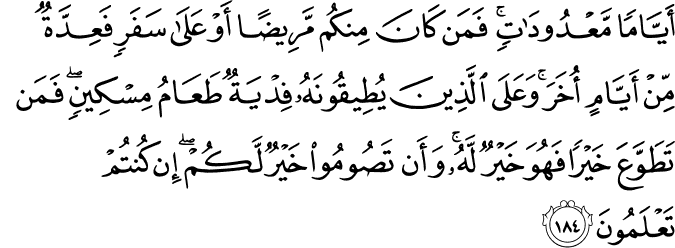
"a limited number of days. So whoever among you is ill or on a journey [during them] - then an equal number of days [are to be made up]. And upon those who are able [to fast, but with hardship] - a ransom [as substitute] of feeding a poor person [each day]. And whoever volunteers excess - it is better for him. But to fast is best for you, if you only knew."


2:1852:185

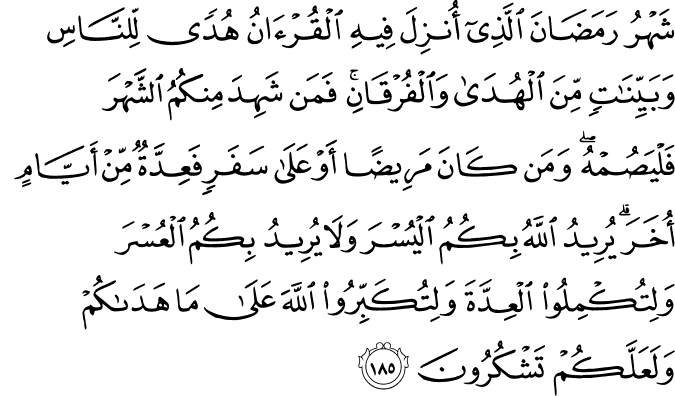
"The month of Ramadhan [is that] in which was revealed the Qur'an, a guidance for the people and clear proofs of guidance and criterion. So whoever sights [the new moon of] the month, let him fast it; and whoever is ill or on a journey - then an equal number of other days. Allah intends for you ease and does not intend for you hardship and [wants] for you to complete the period and to glorify Allah for that [to] which He has guided you; and perhaps you will be grateful."


2:187
2:187
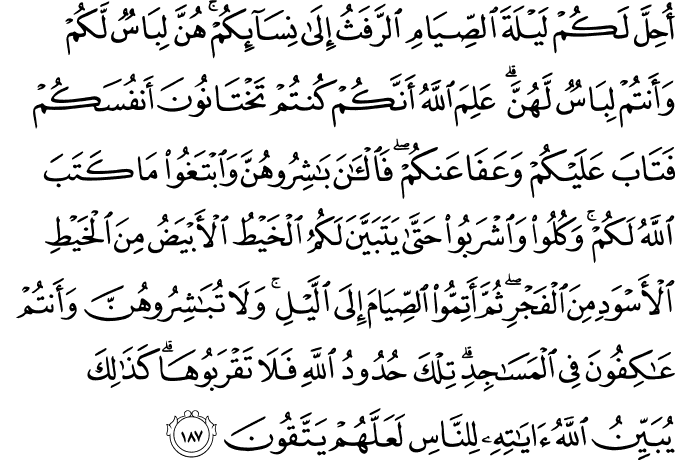
"It has been made permissible for you the night preceding fasting to go to your wives [for sexual relations]. They are clothing for you and you are clothing for them. Allah knows that you used to deceive yourselves, so He accepted your repentance and forgave you. So now, have relations with them and seek that which Allah has decreed for you. And eat and drink until the white thread of dawn becomes distinct to you from the black thread [of night]. Then complete the fast until the sunset. And do not have relations with them as long as you are staying for worship in the mosques. These are the limits [set by] Allah , so do not approach them. Thus does Allah make clear His ordinances to the people that they may become righteous."

                                                                   صدق الله العلي العظيم

   As far as the duration of fasting is concerned the last verse above determines the start time with exact details that is when  "the white thread of dawn becomes distinct to you from the black thread [of night]."

Conversely, the precise time to end the fast is not stated: "Then complete the fast until the sunset."  Interestingly, sunset is not defined as precisely as the dawn time is.  I strongly believe God's use of words has profound philosophy behind it and the words have been miraculously chosen to serve a purpose throughout Quran. It then follows that since God has not purposefully specified a distinguishable ending to the fast time, it has to be meant as a flexible ending.   

   That said, there are three main reasons which could lead us to believe God has intended  an adjustable ending time for Ramadan fast, varying based on location and personal circumstances. Namely: 
  • Wordings of verse 187 is not providing an explicit universal distinction for the beginning of night in contrast with the start time. 
  • It is almost impossible for most people to keep their fast for any length of time above 18 hours and then repeat it for a period of 30 consecutive days.  This will be conflicting with the prior verse 185 at the end of which it reads: "Allah intends for you ease and does not intend for you hardship and [wants] for you to complete the period and to glorify Allah for that [to] which He has guided you; and perhaps you will be grateful."  It would be an unrealistic expectation not to mention being against the earlier words of God.  In other words, it is important to fast in a way that we can complete the specified number of days, as implied in verse 185.  
  • There is already a difference of about 20-30 minutes in breaking the Ramadan fast existing among the two major denominations of Islam. This proves sunset can be inferred legitimately different by believers.   

   Considering the above, if we are to choose between fasting wholeheartedly and neglecting Ramadan fast all together, I believe it would be an act purely out of God's love (="Taghva" ) to fast at a reduced length of time.   

     Last but not least, one may ask if we can define an standard way to shorten the long days to a length of time which would be universally applicable and verifiable.   One solution, as I learned, could be to end our fast based on the sunset time of Mecca.  This makes perfect sense.  I would like to conclude that perhaps Mecca timing should be the maximum hours of Ramadan fast worldwide unless one wants to keep his/hers longer voluntarily. 


Thursday, June 25, 2015

"Hijab" in Quran

   "Hijab", a head covering worn by Muslim women, is probably one of the most controversial issues in Islam.    If I believe in Quran as the book that is true for ever and is applicable to all humans, cultures and places at all times ,contrary to "Hadith" and "Sunna", I would like to know what Quran says specifically about this matter so that I can comply with God's words.  Below are probably all the related verses we can find in Quran.


1:1

24:30
24:30
"Tell the believing men to reduce [some] of their vision and guard their private parts. That is purer for them. Indeed, Allah is Acquainted with what they do."


24:31
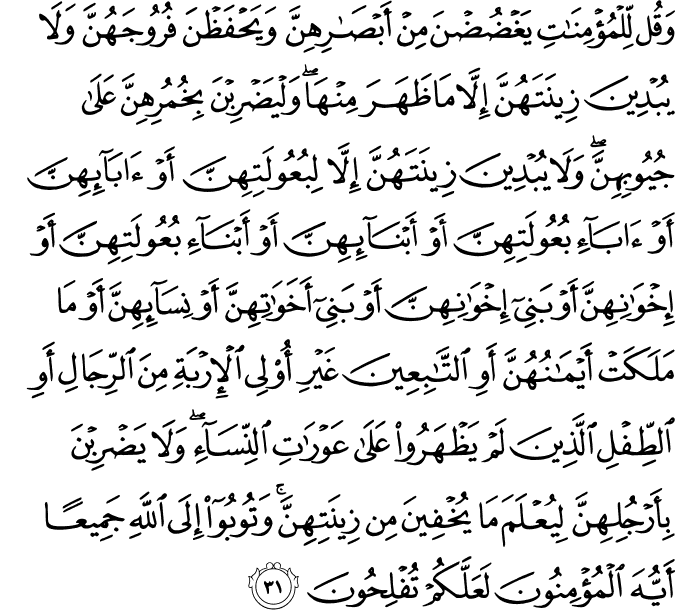
24:31"And tell the believing women to reduce [some] of their vision and guard their private parts and not expose their adornment except that which [necessarily] appears thereof and to wrap [a portion of] their headcovers over their chests and not expose their adornment except to their husbands, their fathers, their husbands' fathers, their sons, their husbands' sons, their brothers, their brothers' sons, their sisters' sons, their women, that which their right hands possess, or those male attendants having no physical desire, or children who are not yet aware of the private aspects of women. And let them not stamp their feet to make known what they conceal of their adornment. And turn to Allah in repentance, all of you, O believers, that you might succeed."


24:60
24:60
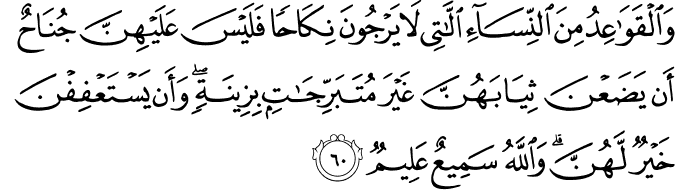
"And women of post-menstrual age who have no desire for marriage - there is no blame upon them for putting aside their outer garments [but] not displaying adornment. But to modestly refrain [from that] is better for them. And Allah is Hearing and Knowing."


33:33
33:33
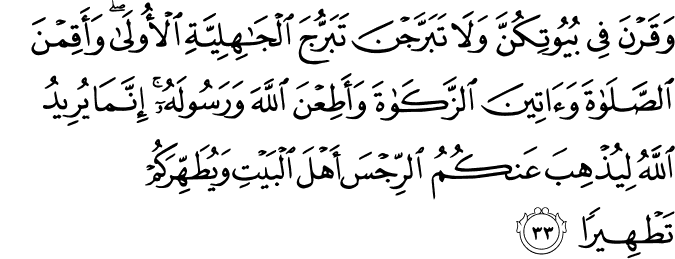
"And abide in your houses and do not display yourselves as [was] the display of the former times of ignorance. And establish prayer and give zakah and obey Allah and His Messenger. Allah intends only to remove from you the impurity [of sin], O people of the [Prophet's] household, and to purify you with [extensive] purification."


33:59
33:59
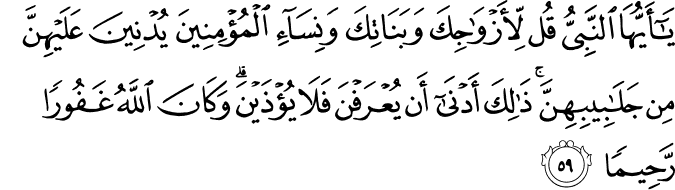
"O Prophet, tell your wives and your daughters and the women of the believers to bring down over themselves [part] of their outer garments. That is more suitable that they will be known and not be abused. And ever is Allah Forgiving and Merciful."


24:30
   This verse is clearly instructing men, firstly, not to stare at women and secondly, it is specifying men's Hijab which is to cover their private parts.   Interestingly, the same two requirements have been repeated for women in the next verse.  Therefore, we can say the basic "Hijab" requirements are the same for men and women.

    What is impressive most in this verse and in the one after is the order to restrict our look because no matter how much men or women cover their body, at the end of the day we will need to keep our sight away from situations that we personally find provocative.  In other words, women's body could be entirely covered as dictated by the norm or by the law of a society but still they prove to be erotic judging from men's behaviour in those places.  This is exactly the case in a number of Middle Eastern countries,   I found this recommendation amazing because it is true regardless of cultural differences and it is a timeless fact.

   Last but not least in this verse, is the relationship between the voluntarily diverting your attention from sexually exciting scenes and becoming purer.  This means we can purify our soul by avoiding something for the sake of God, which is neither illegal nor does it hurt anyone evidently.  This will guide us to understand the fact that the more we align our choices for God the purer our soul will become, which is all we need in life to be saved by God.

24:31
    I believe the main criteria of "Hijab" is defined in this verse in which the particular requirement for women is commanded in addition to the two previous requirements in common with men.  That is women need to cover their adornment (jewellery) particularly their necklace over their chest.  It is stated that worn jewelleries have to be covered as far as one can control it. If they get out of their cover while moving or unintentionally it is understandable.  It is also emphasized that women should cover their chest and if they have under cover jewelry they should not use them to attract attention indirectly, by making them sound for example.

   In other words, what is this verse implies above all is that the distinctive necessity for women is to avoid being erotic by showing any particular parts of their body or their adornments or in any other way. Moreover, this verse defines the meaning of modesty particularly for women in the way they should avoid being seductive in their pose and in their manner.

  The verse continues to define the circle of relatives who are exempt from the third requirement of "Hijab" for women.  When we go through this list of people we notice that these are in fact our closest relationships with whom one feels so close and so familiar that normally sexual attraction would never arise by seeing the adornment or erotic body parts.   

24:60
    For elder women covering the sensual body parts are not as strict although they are still required to cover their adornments.  In this verse again the main principle of modesty is highlighted, which is a very relative concept.   That is to say, "Hijab" in general sense would vary community to community based on the norm of clothing for every community.  Therefore from this perspective, the exact meaning of "Hijab" is the limit of showing body parts.   In reality, it is the personal sense of modesty and shame which determines what exactly to wear and how to behave.  Most people find themselves very uncomfortable if they cross beyond the limits of their individual modesty toward shamelessness.  Needless to say, if someone insist they will find comfort even in wrongdoings but it usually results in emotional disorder over the long term.

   Giving an example, we can consider the naked public events that take place every now and then in different parts of the world. Events such as nude biking or dancing and so on.  What is interesting about these events is the fact that most people find them disgusting and indeed very few people really participate. Otherwise we would have seen an increasing participation trend which is absolutely not the reality.  There are however, always people who make a crowd of audience.  It can be argued that even the public don't identify itself with these activities, judging from the constant number of contestants.  In my opinion,  there is an enormous pressure on the consciousness of both contributors and spectators.   That is because they have neglected their feeling of modesty and shame which, in essence, is the way God distinguishes between virtue from vice inside us.  I believe our consciousness is our virtual heart that differentiates good from bad.


33:33 & 59,
     The last two verses are primarily addressed to the Prophet's wives considering the preceding verses (33 is exclusively for Prophet's wives and 59 primarily, to be exact).   In the latter one, it seems that the purpose of bringing down the outer garment is for the wives of Prophet and for the wives of believers to be disguised among the crowd so that they would not be recognized and would not be harmed.  We can infer from this verse two facts, first it shows that the norm of clothing for women at the time was long garments.  Second, which applies to our time, based on the context of this verse we can submit that if we are likely to be ridiculed or be harmed in anyway due to our beliefs we can make our appearance look like others conforming with the norms of the community.

      In conclusion, to my understanding the underlying message of Quran with respect to "Hijab" is the following :

  1. "Hijab" is a relative concept which is determined by convention of a society and its limit is defined by the feeling of modesty that makes a woman refrain from appearing seductive in public.
  2. There is no explicit command to cover the hair for women whereas it is unambiguously stated that women must cover their adornments and their chest specifically.    

  While "Hadith" meaning the words of our dear Prophet are the most cherished and most loved words to us ever said by any human, there are two issues with them.  For one,  they are not definitely verifiable in terms of their authenticity and their historic context.  Secondly, they seem to be applicable only to the time of Prophet in most cases.  Perhaps "Hadith" has never been meant to be the best way of life for ever  as opposed to Quran's message. Otherwise muslims would have lived their lives in all aspect of life exactly as 1400 years ago, which is needless to prove that is not the case and will never be.  In contrast, Quran invites us to listen to all ideas and choose the best one, or in modern terms Quran is the first promoter of open mindedness.

39:1839:18

"Who listen to speech and follow the best of it. Those are the ones Allah has guided, and those are people of understanding."


                                                                     صدق الله العلي العظيم


Quranic Quotes from www.Quran.com


Saturday, June 20, 2015

Is Stoning Instructed in Quran ?

   There is a misconception among the traditional societies particularly in the Middle East where it is commonly believed that stoning is somehow associated with Quran and it is a sentence  authorized by Quran.  In most cases when they are asked to provide any proof for their claim they mention that the word "Rajm" meaning stoning has been stated in Quran.   Below are the five verses in which this word is used in reference to stoning.  

1:1


11:9111:91

They said, "O Shu'ayb, we do not understand much of what you say, and indeed, we consider you among us as weak. And if not for your family, we would have stoned you [to death]; and you are not to us one respected."

18:20
18:20
Indeed, if they come to know of you, they will stone you or return you to their religion. And never would you succeed, then - ever."


19:46
19:46
[His father] said, "Have you no desire for my gods, O Abraham? If you do not desist, I will surely stone you, so avoid me a prolonged time."


26:11626:116
They said, "If you do not desist, O Noah, you will surely be of those who are stoned."


36:1836;18

They said, "Indeed, we consider you a bad omen. If you do not desist, we will surely stone you, and there will surely touch you, from us, a painful punishment."

                                                                            صدق الله العلي العظيم

   As it is obvious "stoning" is mentioned in these verses only as a threat or as a potential punishment by the infidels offered to the prophets thereby forcing them to stop inviting people to God.  There is absolutely no verse  in Quran where God has set "stoning" as a punishment for any sin or any crime. 

   The question that follows naturally is what then "stoning" is based on as a sentence in those societies.  I believe the only imaginable sources it can be associated with is Hadith and Sunnah. While I have no knowledge of any of these two respectable sources, it is only reasonable to assume that if "stoning" is based on a hadith it is either not a true one or even more reasonably we can say it does not matter which source it comes from.  It is inhuman, immoral and not acceptable to anyone in the right mind.  It is very hard to believe that the religion which has stopped the tradition of burying infant-girls alive would legitimize such punishments.    

   I believe in many of such cases where personal emotional reactions have become a norm, a tradition, it appears that the followers of the religion tend to run over God's commandments thinking that the harsher they react the better God would like their action while in truth it is only to fulfil their personal interests and desires.   Everyday examples include reaction of people from different religions toward anything they gather as an insult to their sacred book, prophet or places. 

     That said, we have to trace religious fanaticism and extremism, generally speaking, in cultures and in individual circumstances rather than blaming it on Quran. 


Thursday, June 18, 2015

Can We Make Our Heart Love ?

   
   Often times we hear that we either feel love in our heart or we don't, there is nothing we can do about it.  Love either already exists or it doesn't we can not create it, in other words.  Well, I am not sure if that is entirely true. 

   How about if we don't eat for long hours of hot summer days because we want to make our heart feel there is something for which we deprive our self from the most basic needs. We willingly take on an apparent trouble for our body to go beyond the martial needs, to hear the voice and to see the light that we would otherwise don't.  It starts from our will, from our wish to change, to make our heart change, to force our perceptions sense a world beyond what the five senses show us, to see the unseen, in truth.    As a result of this seemingly physical action we feel different, our heart feels totally revived.  Keep repeating such actions, or even not, we feel the love that has engulfed our heart and we see the light that has enlightened the world.   Ramadan Mobarak, this is the time we can rejuvenate our heart.   

   Do we have to inflict upon our self 18 hours or so of fasting while we find it unbearable considering our personal circumstances?  I don't think so. We are only expected to try our best for God. What matters, first and for most, is to keep trying good deeds for him ,to the extent that we can afford,  which will shape our true nature for the after life. 


1:1


53:3953:39 
And that there is not for man except that [good] for which he strives

79:35
79:35
The Day when man will remember that for which he strove,

76:2276:22
 "Indeed, this is for you a reward, and your effort has been appreciated."

20;15
20:15
Indeed, the Hour is coming - I almost conceal it - so that every soul may be recompensed according to that for which it strives.


 صدق الله العلي العظيم

Quran Quotes from Quran.com

Saturday, May 2, 2015

How Similar We Are to Moving Creatures?

1:1


6:386:38
Sahih International
"And there is no creature on [or within] the earth or bird that flies with its wings except [that they are] communities like you. We have not neglected in the Register a thing. Then unto their Lord they will be gathered."


45:4
45:4Sahih International
"And in the creation of yourselves and what He disperses of moving creatures are signs for people who are certain [in faith]."
(from Quran.com)

   Although it is an obvious fact that Quran has not been intended to be a science guide for men to discover the world and expand his worldly knowledge, there are fascinating verses every now and then, which are meant to be undeniable signs of God in the nature all around us.  Our similarities with all moving creatures on earth is one of such cases. 

  We can probably study the resemblance between human and moving creatures in two aspects, physical and behavioral. 

  Physically, the first striking similarity in appearance is the symmetrical structure of their bodies.  All moving creatures from insects to animals, birds and human seem to have an amazing symmetry which makes us wonder what it could represent.  Of course, if you ask this question from a science educated person, as I asked,  S/he may answer "Since life grows through a basically symmetrical process of cell division, symmetry in larger forms should not be in any way surprising." Kevin Colby from "Philosophy of Mind", a Google community. 

   I believe it is the same argument with rain and all the other natural phenomena.  If you ask an atheist what is the reason for rain they would most probably tell you that it is about one of the most basic natural science concepts that is the cycle of evaporation and condensation of water.  They will even go further proving their case by explaining that today human is capable of manipulating the water molecules in air and create rain without divine intervention.

   So, while it is true that physical cause of rain or generally the cause for all natural phenomena is another natural cause, a disbeliever would deny a metaphysical driving force underlying the chain of natural causes.  This is despite the fact that throughout Quran God keeps reminding us that there is no slightest movement taking place on earth ,a falling tree leaf for example, without his permission and his knowledge, as emphasized in the verse 6:59. Quran basically claims that it is indeed God who is the only cause for all that is happening in the whole universe.

  We can therefore, see that we may never be able to directly link the seen world to the unseen through science which is based on our five senses unless we want to see God as the ultimate cause of all the developments of the seen world, no matter how small or how large they are.  That is why it will be always a matter of faith ,which is based on findings of our heart, to believe in the unseen in order to qualify for being guided by God.  The kind of guidance that ,for the most part, consists of being  exposed to God sings and miracles on a personal levand and on daily basis, recognizing which would increasingly enable us to see more of God's light lighting the whole world as we move along our life.

   The second physical similarity between us and other moving creatures is having the two main organs of brain and heart.  While I do not have any expertise in biology and I have no intention of providing any scientific claim, it appears some insects, bees and ants (termite) included, have a heart.  What is special with bee and termite is that they are mentioned in Quran in verses 16:68, 16:69 and 34:14.  As stated God has inspired them directly to do specific tasks.

   As far as the behavioral similarities are concerned, in all moving creatures from the insects to the largest animals and including birds they all seem to demonstrate a kind of decision making behavior in their daily life.  That is to say, they all have to go through a thinking process to find their food, to hunt, to keep away from danger and so on.  what is most interestingly is the fact that they also show sings of hesitation when they are deciding based on the information they gather from their environment. This clearly means they have a freedom of choice to a certain degree like human.

  Another amazing behavioral aspect of moving creatures is that they all seem to have feelings and emotions.  The numerous videos on the Internet showing one animal helping another of his species or even from other species ,in rare cases, evidence this. Also they way they take care of their family members or show emotional reactions to human is more or less corroborating the same fact.   Dogs of course are known to have the highest emotional understanding when it comes to interactions with human.

   Based on the above arguments, I wish to draw the following conclusions as a matter of personal opinion.
  1. The similar physical symmetry in the appearance of the body and in the main organs of moving creatures including birds with that of human could mean that these creatures have also a metaphysical side of their being which is commonly referred to as soul in a very general sense.  
  2. Having the same main organs of brain and heart as human's could mean that other moving creatures potentially have a freedom to choose between good or bad through a kind of thinking process similar to human's and also because they have heart they could be inspired by God directly again similar to the same capability of men.   
   Finally, we can perhaps, conclude that since all moving creatures have souls, have freedom of choice, and they can be inspired by God hence they will also be held accountable for their actions just like human will in after life.  This is how I believe the first verse at the top of this page can be understood when God says :

"And there is no creature on [or within] the earth or bird that flies with its wings except [that they are] communities like you. We have not neglected in the Register a thing. Then unto their Lord they will be gathered."

 صدق الله العلي العظيم


From Google images

Monday, April 27, 2015

What does “Fear of God” mean in Quran?


1:1

   There are three words “Tagva”, Khashyah” , and “Khouf” from Quran which have been equally translated to fear in most translation of Quran as far as I have seen.  While it appears that in most cases they could mean the same thing at the first glance, I believe, they are meant to convey delicate nuances which may lead to significant differences in the way we know God.   After all, the extraordinary choice of words throughout Quran never ceases to amaze me.  That is for sure one of the clear signs testifying that this text can only be the words of God.


    As I have already mentioned my understanding of “Tagva” in a previous post, I will be focusing on the other two words “Khashyah” and “khouf” in this one.   The following verses are a few samples where “khashyah” is used:

2:45
2:45

Sahih International
"And seek help through patience and prayer, and indeed, it is difficult except for the humbly submissive "[to Allah ]


79:19 
79:19
Sahih International
"And let me guide you to your Lord so you would fear [Him]?'"


79:2679:26
Sahih International
"Indeed in that is a warning for whoever would fear [ Allah ].


17:31
17:31
Sahih International
"And do not kill your children for fear of poverty. We provide for them and for you. Indeed, their killing is ever a great sin."


    What is in common in the way the word "khasiah" خشیه has been used in the above verses, is in fact its connotation of a current concern for a future event.   Just like "tagva" تقوا,  khasiah is also a state of heart in which fear of doing something that God may not like is present.   That is not to say, doing something out of a blind fear but it is doing or avoiding an action of the fear of losing God's satisfaction.  That means asking ourselves continuously what if God does not like it and then you avoid doing that.  In contrast "tagva" is doing something that God likes, you know that he likes you to do this or he likes you avoid something.   Perhaps, we can see "Tagva" and "khashia" as the two sides of one coin which is the love of God. 

And blew are a few verses including "khouf" or fear:

13:12
13:12
Sahih International
"It is He who shows you lightening, [causing] fear and aspiration, and generates the heavy clouds."


79:40
 Sahih International
79:40"But as for he who feared the position of his Lord and prevented the soul from [unlawful] inclination,"

3:1753:175
Sahih International
"That is only Satan who frightens [you] of his supporters. So fear them not, but fear Me, if you are [indeed] believers."


I believe, what the word "khouf" خوف, commonly represents in the above verses is the fear that results from feeling powerless, feeling tiny, and feeling humble in encountering God's manifestations of his greatness.   This is the kind of fear we feel when we see and hear a lightening or we look into the universe and it is not the fear of a punishing God that forces his servants to blind obedience.

One may argue that there are many warning verses in which dire consequences such as hellfire is notified. Don't they cause any fear ?  Yes, of course the detailed descriptions of hell are truly dreadful.  Yet, amazingly enough, God has repeatedly clarified that these are the consequence of our actions. In other words, we, ourselves, are choosing the severe hardships that we may have to go through on our path of eternal spiritual evolution.   God is frequently emphasizing and warning us to avoid or to keep away from that path which is the hard way of learning and evolving.

Therefore, keeping in heart the greatness of God is a strong deterrent against giving in to our ego.  In the meantime, God's greatness can empower  us with a hope that even in the darkest situations of life God's will can prevail and there is no reason to become hopeless ever.  There is vidoe on youtube in which a man is free jumping from space interestingly just before he jumps (around minute 2:05) he says, "sometimes you have to be really high to see how small you are" https://www.youtube.com/watch?v=VKojXTWJIhg. 

Finally, we may have heard that Quran is a live book and may have wondered what it means. So in case we were seeking God's help to distinguish between these three words (as I were) we may accidently find this verse (as I did) which miraculously presents "Tagva", "khashia" and "khaouf" all in one verse.


4:9
4:9
Sahih International
"And let those [executors and guardians] fear [injustice] as if they [themselves] had left weak offspring behind and feared for them. So let them fear Allah and speak words of appropriate justice."


                                                              صدق الله العلي العظيم